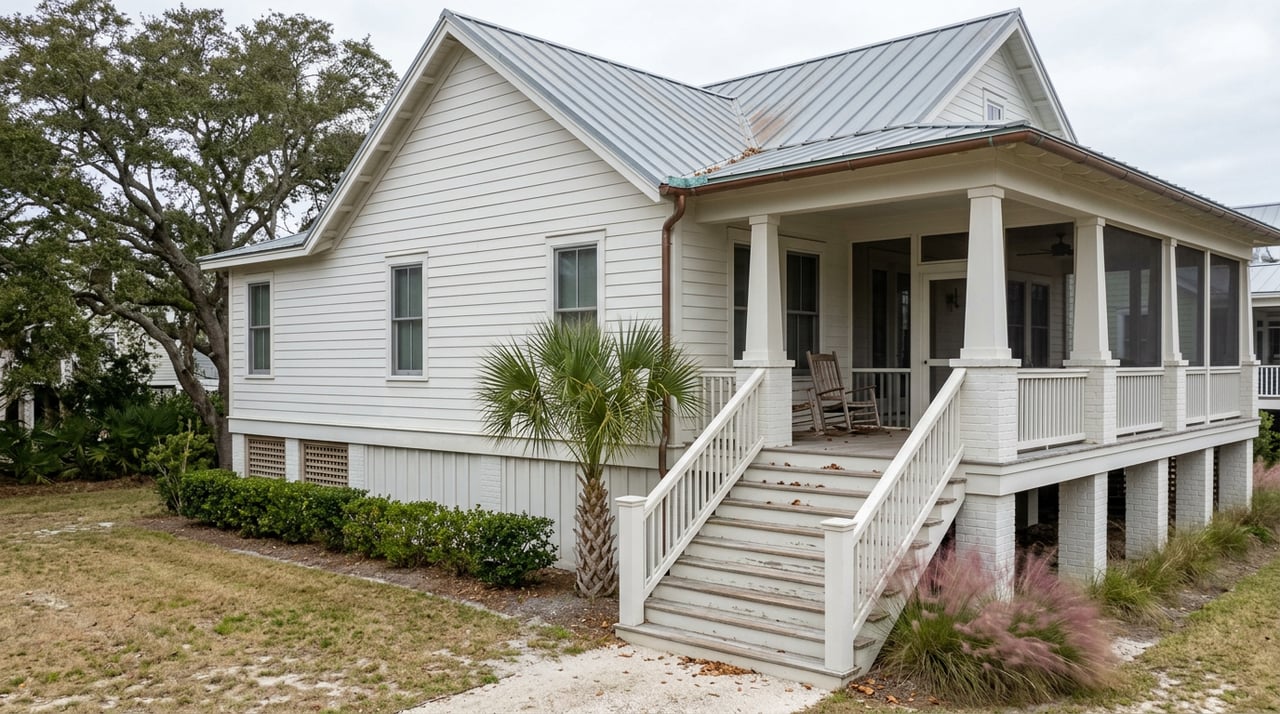
Drive down Myrtle Avenue past the mid-island historic district and you will pass one lot doing double duty as a small case study in exactly what Pawleys Island is arguing about right now. On one side sits Liberty Lodge, a nineteenth-century house old enough to be named in the island's original National Register listing. On the other, until recently, sat Port Arthur, a 1940s beach house on the same parcel. The owners wanted to renovate the older structure and take down the newer one. In 2024 the town's Board of Zoning Appeals said yes, on the condition that Liberty Lodge be preserved in perpetuity and that whatever replaced Port Arthur be capped at no more than 50 percent larger than what stood there before.
That should have settled it. It didn't. When the replacement design came back to the town's Architectural Review Board, the board voted 5-0 to deny it, arguing the plan looked more like a contemporary infill house than something that belonged next to a nineteenth-century neighbor in a historic district. One member called the size and massing a missed opportunity. Another asked, out loud, whether anyone else in the room was uncomfortable with how much the square footage had grown between the variance and the drawings.
That one lot captures a tension the town has been circling for five years: everybody says they want to keep Pawleys looking like Pawleys, but the rules already on the books have been quietly working against that goal.
The rule nobody voted for on purpose
The pressure toward demolition doesn't come from a developer or a market trend. It comes from a federal flood rule that Pawleys Island, like every community in the National Flood Insurance Program, has to enforce. If the cost of renovating a house equals or exceeds 50 percent of its value, the whole structure has to be brought up to current construction standards, which on a barrier island means elevation. For an old beach house with a low profile and original bones, that math often makes a full teardown-and-rebuild cheaper and easier than a careful renovation.
Pawleys Island then added its own layer on top of the federal floor. Town rules require V Zone construction standards everywhere within town limits, including in A Zones where the federal minimum would normally be less strict, which means the lowest structural member of a substantially improved house has to sit at least three feet above base flood elevation. It's a conservative standard, and town officials have defended it for the insurance discount it earns the whole community. But it also means any house that trips the 50 percent threshold gets jacked considerably higher than its neighbors, whether the owner wanted that look or not.
Planning Commission chair John Hildreth has been blunt about where this leads if nothing changes: "We are going to be a skyscraper beach community." He's also been direct about the connection to the ordinance the town is racing to finish: "A lot of what we're doing now with historic preservation is to keep from jacking the houses way up."
Being on the National Register doesn't do what you'd think
Here's the part that surprises longtime residents when they look into it. A house individually listed on the National Register of Historic Places is already exempt from that flood elevation trigger. What it isn't exempt from is a bulldozer. Brad Sauls, who runs local government assistance for the State Historic Preservation Office, told the town's Planning Commission flatly that National Register status is only honorific and that there are no mythical preservation police standing between an owner and a demolition permit.
That gap is the whole reason the current ordinance push exists. A National Register listing can spare a house from the elevation rule. It cannot require anyone to keep the house standing in the first place. The town has been trying to build the second half of that protection at the local level since 2021, when it adopted design guidelines for new construction and created the Architectural Review Board, largely in response to a run of older homes coming down to make way for larger new ones. Commission members have discussed extending the board's authority to cover demolition decisions on listed properties, not just new construction, as part of getting that second half right.
| National Register listing (status quo) | Local historic designation (proposed ordinance) | |
|---|---|---|
| Exempt from the town's flood elevation rule | Yes, if individually listed | Yes |
| Enforceable demolition protection | No, honorific only | Being built into the ordinance's review process |
| Requires review before exterior changes | No | Yes, via a Certificate of Appropriateness |
| Routine repairs that don't change appearance | Not regulated | Not regulated |
What the draft ordinance actually builds
The town's own historic preservation page lays out a June 2026 draft that would create the local machinery the National Register never had. In practice it sets up:
- A nomination form owners can file to add a property to a new List of Local Historic Properties
- A Certificate of Appropriateness requirement for exterior renovation or replacement work on listed properties
- An explicit carve-out so routine maintenance and repairs that don't change a house's appearance still don't need approval
- A path toward the town becoming a state-certified local government, which unlocks the tax incentives that make preservation less of a one-sided ask for owners
None of that bans anyone from tearing down a house that isn't on the list, and nothing in the draft reaches backward to regulate homes that aren't old enough to qualify. What it does is give the town a formal review step, tied to real incentives, in the gap where an honorific listing used to leave owners on their own.
A deadline that lands this month
The town held a public hearing on the ordinance on July 13, 2026, and Mayor Brian Henry told local media at Georgetown County's State of the Community event on September 1 that adoption could come as early as this month. Henry framed the stakes in plain terms: "What makes Pawleys so unique and different and special is our history, our uniqueness, our arrogantly shabby vibe. We want to maintain that at all costs."
He also connected the preservation push to a second, unrelated problem the town is contending with at the same time. Pawleys Island has been dealing with flooding even on clear, sunny days as tides and storm patterns shift, and officials have said a drainage fix is designed but waiting on state and federal funding. Separately, a beach renourishment project is now expected to start sometime between late 2026 and early 2027. None of that changes the preservation timeline directly, but it's a reminder that the town is trying to solve several water-related problems at once, on a barrier island where nearly every rule eventually traces back to how close the water sits to your foundation.
What this actually means if you already live here
If your house predates the mid-twentieth century and sits inside the roughly 1.8-mile historic district that runs along Myrtle Avenue, this ordinance is worth tracking even if you have no plans to sell or renovate anytime soon. Early committee discussions floated structures that predate Hurricane Hazel in 1954 as a possible starting point for what counts as historic, though the final criteria in the adopted ordinance may land differently. If your house qualifies and you nominate it, you'd be trading some oversight on exterior changes for real protection from both the bulldozer and the flood rule that's been quietly reshaping the block one renovation at a time.
If your house doesn't qualify, the practical effect of this whole effort is still visible from the sidewalk. It's the reason some houses on the island sit low and original while their neighbors, rebuilt after tripping the 50 percent threshold, now stand noticeably taller. Once you know the mechanism, you stop reading it as random variation and start reading it as the town's flood code, working exactly as designed, just not in the direction anyone particularly wanted.
As for the Liberty Lodge lot, the story isn't finished. The Architectural Review Board sent the design back once already, and whatever eventually gets built next to that nineteenth-century house will be one of the first real tests of how seriously the town's design review process takes the difference between old and new on the same piece of ground. It's worth a look next time you're on that stretch of Myrtle Avenue, because it's a preview of the standard the rest of the island is about to be held to.
If you're curious how any of this touches a specific address, whether it's already nominated, sitting in the flood zone, or just old enough to raise the question, the Taylor Keenan Team tracks these town decisions closely because we live and work in this district too. Reach out anytime you want a straight answer about what a piece of Pawleys Island history actually means for the house on it.