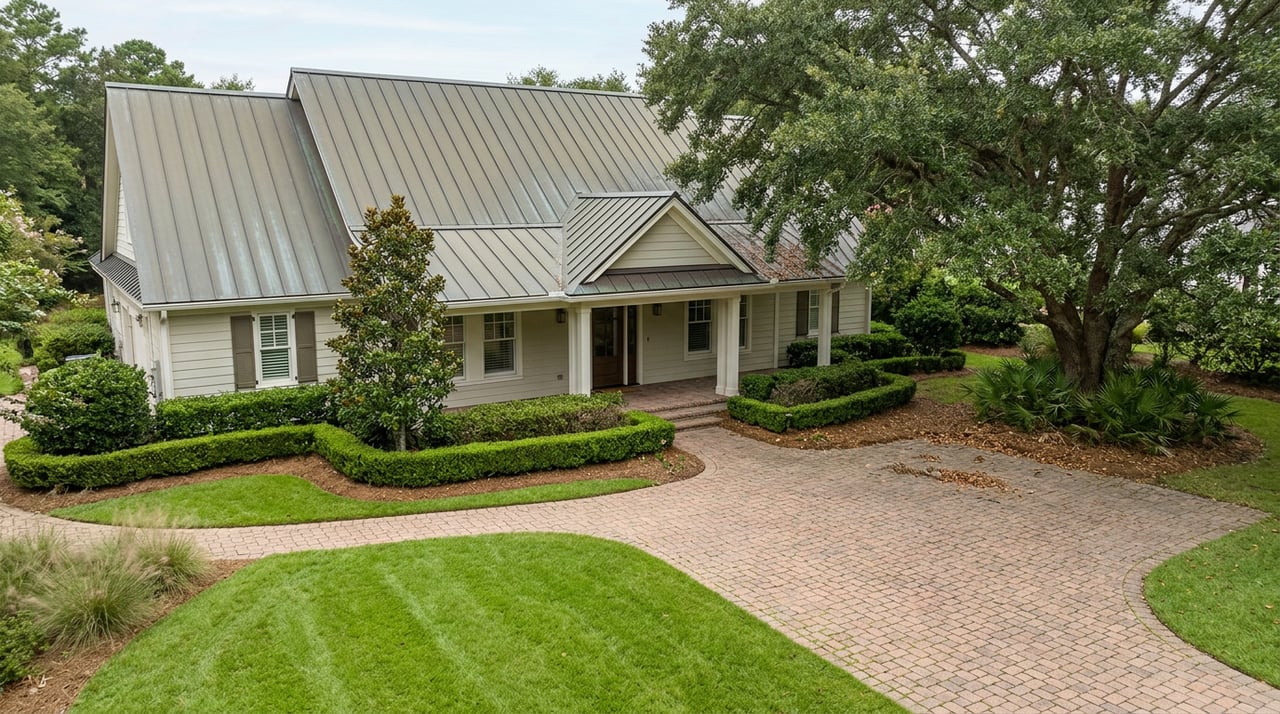
Ask anyone touring homes in Litchfield Country Club the question they're actually thinking: if I buy here, do I have to join the country club? The honest answer surprises most buyers coming from other gated communities on the Waccamaw Neck. You don't have to join. You never did. And the reason isn't a modern HOA-avoidance trend. It's a structural leftover from 1966, when the golf course and the neighborhood weren't even the same idea yet.
Everywhere else along Pawleys Island's golf corridor, the club and the community tend to be woven together, sometimes governed by overlapping boards. Litchfield Country Club is the exception, and understanding why changes what a buyer should actually be evaluating when a listing says "golf course community."
The Club You're Not Required to Join
Litchfield Country Club's residential side is represented by the Litchfield Country Club Property Owners Association, a South Carolina corporation that has operated for more than fifty years. Membership in that POA is voluntary. Of the more than 500 residences inside the community, more than 400 households currently belong, making it one of the largest property owners associations in Georgetown County. What the POA covers stays on the residential side of the fence: common areas, community standards, that kind of thing.
The golf course and the clubhouse, including the dining room, sit outside that structure entirely. Per the POA's own site, both are owned and operated by Founders Group International, a golf management company with no residential governance role in the neighborhood at all. Membership at the club is a straight commercial relationship between a golfer and FGI, priced the same way it would be for anyone else in the region who wanted to join, not something tied to owning a lot on Parkview Drive or Sweetgum Drive.
FGI describes the arrangement about as plainly as a golf operator ever will. On its own site, it sums up Litchfield this way:
a country club environment without the country club price
That's marketing copy, but it also happens to describe a real structural gap accurately. The neighborhood supplies the setting. The club supplies the golf. Neither one requires the other.
Why the Split Happened in 1966
The decoupling isn't a design choice anyone made recently. It's baked into how the course got built in the first place. In the mid-1960s, Litchfield Inn owner Bill Jones was worried about empty rooms once the summer season ended. A businessman named Tommy Farr suggested the fix: build a golf course to give visitors a reason to keep coming after Labor Day. Jones, Farr, and a handful of other investors bought roughly 500 acres from International Paper Company and built what became one of the first eight golf courses on the entire Grand Strand, opening November 16, 1966. This November, the course quietly turns sixty.
That origin story matters because it tells you who the course was built for. It wasn't a homeowner amenity waiting for houses to be platted around it. It was an occupancy engine for a hotel, with residential lots coming later, starting around 1998 and mostly filling in through the 2010s, as a separate real estate proposition riding alongside a golf course that already had its own reason to exist and its own owner. Nobody had to negotiate a handoff of governance from a developer to future homeowners, because the golf course was never the homeowners' asset to begin with.
What Buying Here Actually Costs You
The practical upshot shows up the moment you compare Litchfield Country Club to a bundled community a few miles up Highway 17. At Pawleys Plantation, for instance, golf and social memberships are structured and priced directly by the club as tiers of ownership experience, with an initiation fee up front and recurring monthly dues layered on top, whether or not every homeowner actually golfs. At Litchfield Country Club, there's no such tier to opt into by default. Your carrying costs as a homeowner are set by the voluntary POA, not by anything happening at the clubhouse.
| Litchfield Country Club | A bundled-membership community (e.g., Pawleys Plantation) | |
|---|---|---|
| Neighborhood dues | Voluntary POA dues, covers common areas only | HOA/POA dues generally mandatory |
| Golf club relationship | Separate commercial membership through Founders Group International, fully optional | Membership tiers marketed and priced directly by the club, often expected of owners |
| Gated entry | No | Typically yes |
| Resident governance of the course | None | Some club governance may be tied to membership status |
That table oversimplifies a little, every community has its own fine print, but it captures the real difference. Litchfield Country Club is also one of the few golf-course neighborhoods on the Neck that isn't gated at all, which is part of why dues never got built into a guardhouse budget the way they did elsewhere. Homes here range from just over 1,200 to nearly 6,000 heated square feet, a mix of ranch layouts and raised beach-style construction, brick and siding side by side, on lots that back to fairways, lakes, or simply mature oak canopy. A buyer choosing this neighborhood is choosing lower, more predictable fixed costs and a golf relationship that's entirely optional. A buyer choosing a bundled community is choosing a higher baseline in exchange for the sense that owners collectively have some stake in the club's direction.
The Governance You Don't Get
That second half of the trade is worth sitting with before assuming "no HOA" is a pure upside. Because residents never held an ownership stake in the course, they also don't have a governance seat if Founders Group International decides to change anything about how it operates. FGI runs more than twenty golf courses across the Myrtle Beach area, which means decisions about any one course, including this one, get made in the context of a larger portfolio, not a neighborhood meeting. If the company ever repriced membership sharply, changed hours, or repositioned the course, the POA has no formal lever to pull. It was never their asset to have a say over.
That's a real trade-off, not a defect anyone hid from you. Plenty of buyers prefer it, precisely because it means their monthly costs aren't exposed to the club's decisions the way an owner's dues are in a bundled community. But it's worth being honest about the asymmetry going in rather than discovering it later.
Sixty Years of the Same Fairways
For what it's worth, the course itself has given residents little reason to worry about that asymmetry so far. Designed by Willard Byrd and opened in 1966, it plays at 6,752 yards from the back tees, a par 72 with sharp doglegs and small, forgiving greens that have made it a longtime favorite of women and senior golfers who don't need length to enjoy a round. It has operated much the same way for six decades: semi-private, open to the public as well as to members, without chasing the resort-scale renovation cycles some newer Grand Strand courses have taken on. Stability like that doesn't require residents to hold a stake in the business. It just requires the business to keep doing what's worked since 1966.
Three Questions Worth Asking Before You Write an Offer
- Does the lot actually back to the course, or does it border shared green space that only feels like course frontage? Course-adjacent lots carry a different value story even when nobody involved is a club member.
- What are current membership rates at the clubhouse? They're set by Founders Group International, not published in any listing paperwork, so you'll need to ask the club directly rather than assume a number from a neighboring community.
- What exactly does the voluntary POA cover, and what doesn't it? Confirm the boundary before you budget, since the answer won't include anything happening on the golf side of the fence.
None of these questions have a wrong answer. They just have answers a buyer should hear before closing, not after.
If you're comparing Litchfield Country Club against other golf-course neighborhoods on the Waccamaw Neck and want a straight read on how each one actually structures ownership, not just what the listing photos suggest, the Taylor Keenan Team spends its days inside these distinctions. Reach out and we'll walk you through what you're really buying, club membership included or not.