The listing sheet for a True Blue condo tells you the price, the square footage, and the monthly regime fee. It does not tell you whether that building will still qualify for a standard mortgage in under five months. That second question, not the first, is the one worth asking before you write an offer.
Here is the thesis in one sentence: a federal rule taking effect for loan applications dated January 4, 2027 is about to test every condo association in South Carolina that has never done a reserve study, and True Blue's building stock, most of it raised between 1998 and 2004, sits squarely inside that test group. The price you see today assumes financing stays easy. It might not.
The Math Just Changed on Every Older Condo Building
For years, Fannie Mae and Freddie Mac have required condo associations to direct at least 10 percent of their annual assessment income into reserves before a loan on a unit in that building could be sold on the secondary market. Starting with loan applications dated January 4, 2027, that floor rises to 15 percent. Miss it, and a building risks losing its "warrantable" status, the designation that lets a buyer get a conventional loan there at all. That is not a cosmetic distinction. It drags down financing options, and eventually values, for every unit in the building, not just the one you happen to be buying.
There is a way around the flat 15 percent number. An association with a reserve study completed within the past three years, funded at that study's own highest recommended level, is exempt from the blanket rule. In other words, the associations that already did the unglamorous work of hiring an engineer to walk the property and price out the roof, the paving, and the pool equipment get to keep their current funding target. The ones that never bothered get a higher bar dropped on them with less than five months' notice from today.
True Blue Was Built Right Into the Gap
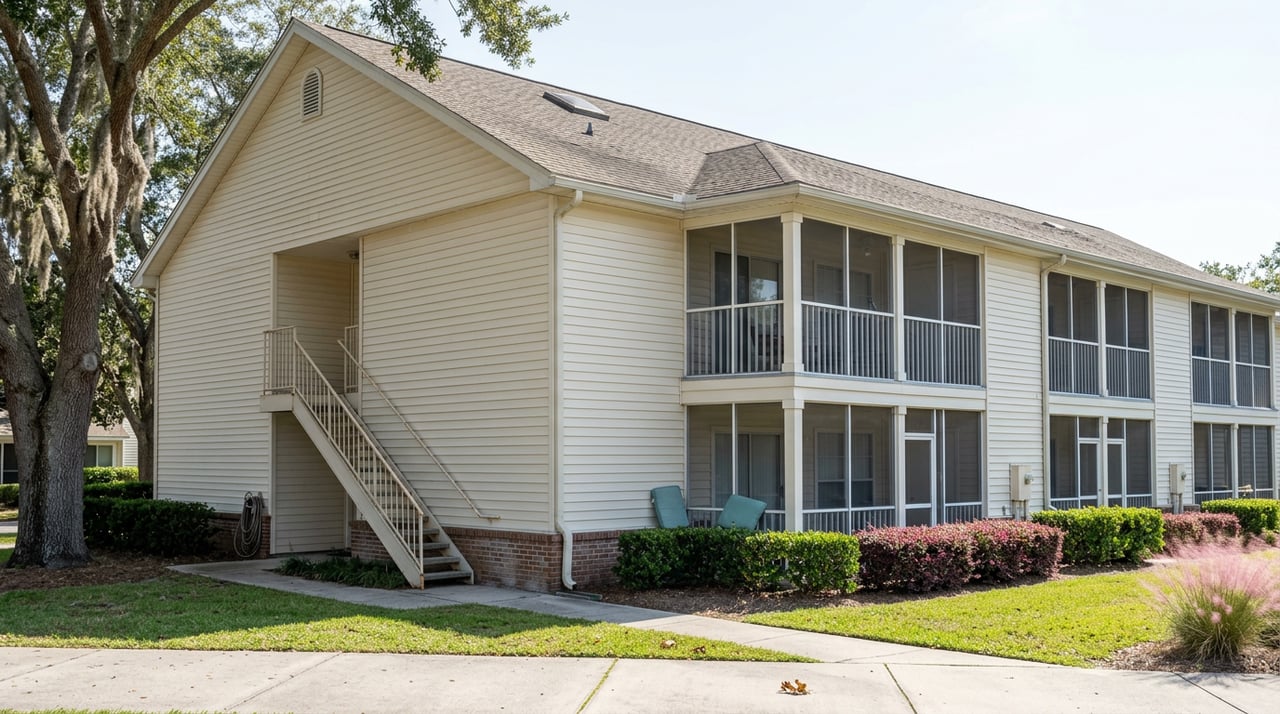
True Blue's condo buildings were not put up last year. MLS year-built records for units across True Blue 1 show construction dates of 1998, 2000, 2002, 2003, and 2004. The neighboring Egret Run community, built around the same course and sharing much of the same buyer pool, dates to 2000. These are not new-construction associations with a decade of cushion before a major roof or paving cycle comes due. They are twenty-plus-year-old buildings entering exactly the stretch of life where reserve planning stops being optional and starts being arithmetic.
None of this means True Blue's associations are underfunded. It means the age of the buildings puts them in the population where the question actually matters, and a buyer has no way to tell from a listing photo or a square footage number whether the board did the reserve study or skipped it.
What South Carolina Never Asked Associations to Do
Here is the part that catches people off guard. South Carolina's Horizontal Property Act, the state law governing condominiums, requires an association to maintain its common elements and collect adequate assessments. It does not specify how a board should calculate those assessments or plan for future replacements, and it does not require a reserve study at any interval. The state's Homeowners Association Act, which covers planned communities more broadly, has the same gap. Neither law forces a board to hire someone to walk the roof and price out the pool deck.
That silence used to be a manageable ambiguity. A board could run reserves lean for years, lean on special assessments when something big failed, and never run afoul of a state inspector because there was no state inspector checking. What changes in 2027 is that the federal lending requirement, which used to sit quietly in the background, becomes the only backstop, and it is about to ask for 50 percent more reserve funding than it used to.
An association that wants to avoid the flat 15 percent rule has one real option: complete a reserve study now, fund it to the study's own recommendation, and keep that documentation current. An association that has never had one done is starting from behind, on a deadline it may not have been tracking.
The Four Questions That Matter More Than the Price Sheet
If you are looking at a True Blue condo this fall, the questions that actually protect you are not about granite counters or vaulted ceilings.
- Has the association completed a reserve study, and if so, when?
- Is the association currently funded to that study's recommended level, or below it?
- Has your lender confirmed the building's warrantable status for a conventional loan, and did they check it against the 2027 threshold, not just the current one?
- What does the last twelve months of board meeting minutes say about insurance renewals or discussion of a special assessment?
None of these questions require you to be an accountant. They require you to ask, and to get the association's financial documents before your due diligence period closes rather than after.
What This Means If You're Comparing True Blue Against Newer Product
Buyers weighing True Blue against a newer Grand Strand condo often frame the decision purely on price and finish level. True Blue's regime fees, one recent listing for a 2004-built unit showed a monthly fee around $359, typically bundle exterior building insurance, cable, internet, water, sewer, and trash into one payment, which reads as a convenience compared to paying several of those separately in a single-family HOA. Along the wider Grand Strand, regime fees on condo buildings can run anywhere from roughly $200 to well over $1,500 a month depending heavily on the building's age and its insurance costs, and some Grand Strand oceanfront buildings saw their insurance premiums double or triple between 2022 and 2025 as carriers reassessed their appetite for South Carolina coastal risk.
The comparison that actually matters is not this year's fee against that year's fee. It is whether the association behind the fee has already done the reserve math the federal government is about to require, or whether that cost is still sitting ahead of the building, waiting to show up as a special assessment or a financing headache for the next buyer. A newer building may not have this problem yet simply because it has not lived long enough to need a major roof replacement. An older, well-run building with a current reserve study may be in better shape than a newer one that has never looked at the question at all. Age alone does not answer it. The documentation does.
A Few Straight Answers
Does this affect single-family homes in the wider Pawleys Island area, not just condos? No. The 15 percent reserve floor applies specifically to condominium associations under Fannie Mae and Freddie Mac guidelines. Single-family HOAs are not subject to this particular rule, though South Carolina's HOA law has the same lack of a state-mandated reserve study requirement.
If a building fails to meet the new standard, does that mean I can't buy there at all? Not necessarily. It generally means the building could lose eligibility for standard conventional financing, which narrows your loan options and can affect what future buyers are able to offer, which in turn affects resale value. Cash buyers and certain portfolio lenders may still have options in a non-warrantable building.
Is a reserve study something I can request to see as a buyer? Yes. Reserve studies and recent board financials are part of the association documents a buyer should request during due diligence. If the association cannot produce one, that absence is itself useful information.
Buying into a golf course condo community like True Blue is still one of the more accessible ways to plant a flag on this stretch of the Lowcountry coast. The team at the Taylor Keenan Team spends a lot of time reading HOA documents so our clients do not have to guess. If you are comparing True Blue against other options on the Grand Strand, or you already have an offer in hand and want a second set of eyes on the association's financials before your due diligence period closes, start your Lowcountry search with our team today.