Around 1 p.m. on September 30, 2022, the east end of the Pawleys Pier broke loose and floated away. Owners staying at Pawleys Pier Village filmed it as Hurricane Ian came ashore on North Island. In the video, a tattered American flag was still flying over the fishing pavilion. Ian took about a third of the structure. What survived has stood on the beach as a stub ever since.
The replacement is now permitted. Demolition was scheduled to begin in late October or November, and the new pier is expected to be finished in February 2028. Almost every design choice is meant to bring back the pier the island remembers. The deck is the exception. The project's engineer calls decking the reason ocean piers fall down, and if the new deck goes in as planned, you'll be able to see the difference by walking the beach underneath.
A pier built to match the one that left
The pier is private. It belongs to Pawleys Pier Village, a condominium community at 320 Myrtle Avenue at the end of the north causeway, and the community's homeowners association is running the rebuild. Pawleys Island Town Council still reviewed the design closely. Mayor Brian Henry told council, "We want to make sure it's an aesthetic fit for the island," according to the Coastal Observer.
The HOA's answer was to copy the old pier. The remaining 553 feet will be torn down and the replacement built in the same footprint. "The end will look like the old one did with a light pole right on the end and a pavilion," Wade Warr, president of the Pawleys Pier Village Homeowners Association, told the Coastal Observer. According to the state permit application as reported by the paper, the pier will have three sections:
| Section | Length | Width |
|---|---|---|
| From Pawleys Pier Village toward the ocean | 194 feet | 12 feet |
| Middle walkway | 490 feet | 24 feet |
| End section with the pavilion | 116 feet | 48 feet |
Council members worried that the new pier might be built of concrete or steel. "It will be a wooden pier," Warr said. Henry told The Post and Courier that the town is glad the replacement won't be a massive concrete structure: "I don't think that fits the aesthetic of Pawleys Island and the kind of laid-back vibe."
This is the pier's fourth start. It opened in July 1954 and was washed away by Hurricane Hazel three months later. It was rebuilt the next year, destroyed by Hurricane Hugo in 1989 and rebuilt again in 1990. The Ian rebuild has taken longer than the others. The HOA had the pier insured for $5.5 million and started planning right after the storm, hoping to begin construction in 2024. It applied for state and federal permits at the end of that year.
Why the deck is the one thing changing
E.B. Pannkuk, the project's engineer, has worked on seven ocean piers. He told council the deck "is why ocean piers fail, why they fall down." He explained it to the Coastal Observer. Nails work loose from wooden decking, so they often get replaced with screws. That holds the boards more firmly, and when waves rise under the pier, the deck pushes upward and lifts the structure with it.
The HOA is considering a fiber-reinforced polymer deck with a grate pattern instead of solid wood, "if it's not cost prohibitive," Warr said. Pannkuk described the main benefit: "any wave that hits it will pass straight through." Coastal Carolina News explained the same mechanism. Water pressure passes through the grating instead of building up against solid planks, so the force doesn't reach the support pilings below.
The grating ran into a town rule. Council Member Paul Groce pointed out that the town's development ordinance requires decks to be wood. "I hate for us to set a precedent," he said. "It's part of the Pawleys look." The proposed answer is wood trim along the sides, which Pannkuk said would hide the decking from anyone looking at the pier from the side. The Post and Courier described the plan as a fiberglass-reinforced walkway with wooden boards along the sides to keep the classic appearance.
What it looks like from the sand
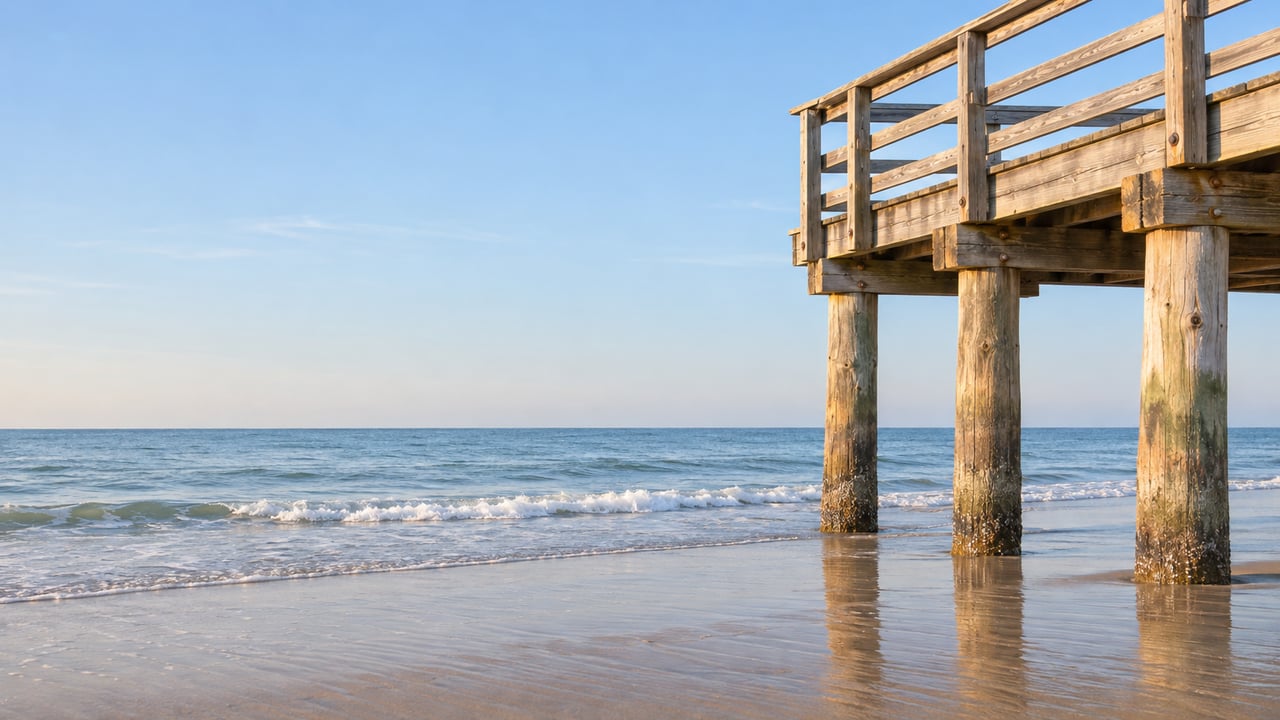
That trim works for anyone looking at the pier from the side, whether from the beach or from a porch up the strand. It doesn't help from directly underneath. Pannkuk told council the grating will be visible to people who walk under the pier.
If the grate goes in, two things will be different for anyone walking under the pier:
- Light. The grating lets sunlight through, and Pannkuk said that means less impact on the dune plants beneath the structure.
- A view of the water below. At Oak Island, North Carolina, part of the public fishing pier was rebuilt with FRP grating, and Pannkuk said there was concern that people would be uncomfortable looking down into the water.
With a grated deck, the light coming through it, the open grate overhead and the dune plants getting more sun would all be visible from the sand. From Myrtle Avenue, the pier should look much like it did before Ian.
The noisy months come first
The construction schedule matters most to people who walk the beach in the off-season. S&C Construction, a company from Wilmington, North Carolina, will do the work. Clint Roberson of S&C told council that crews will demolish and rebuild from land as far as the tide allows, then work "top down" from sections of the old pier.
Fewer than 200 pilings need to be driven, and they may be vibrated into place. If they have to be hammered, Pannkuk said that will happen in stages early in the project. "It's not 14 months of pile driving," he told council.
Beach closures follow the same pattern. "There will be a time when they can't be there," Roberson said, but he added that closures would be limited to times when equipment and materials are being moved. Police Chief Mike Fanning had already seen how beachgoers handle closures:
"We've been down this road before as far as closing the beach down. People don't want to listen."
Officials told The Post and Courier that the first few months of demolition and construction will disrupt the beach. Once the structure reaches the water, most of the work will be overhead and beachgoers will be able to walk underneath. Coastal Carolina News reported that the piling work will require temporary beach closures and staging zones near the site. A sea turtle advocacy group is working with the project to make sure no turtles are on the beach when construction starts during nesting season.
On the late-fall schedule, demolition and the early work near the shoreline would come in the off-season.
In The Post and Courier, Wade Warr, who also manages Pawleys Pier Village, said the pier stands with the Sea View Inn, the Pelican Inn and Pawleys Island Chapel as part of how residents and visitors recognize the town. His family has been coming to the island since the 1950s. "It's iconic," Mayor Henry said. "It's just part of the topography of the island." If the schedule holds, the light pole and pavilion will be back at the end of the pier in February 2028, the first full rebuild since 1990.
We walk this beach too, and we'll keep following the pier's progress one season at a time. If you'd like a local read on the island, its landmarks or what's changing along the shore, Taylor Keenan and our team are glad to talk. Start your Lowcountry search and contact our team today.