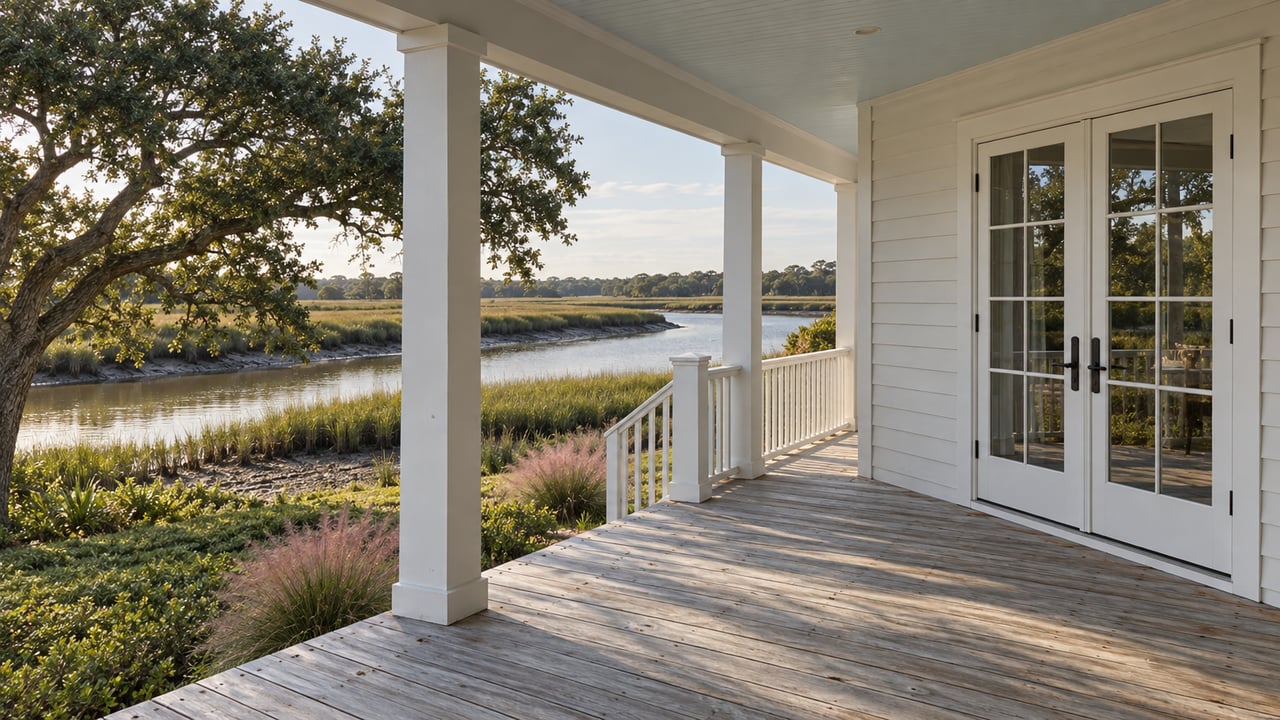
Bud and Melesa Watts own two oceanfront lots at the northern tip of Prince George, along with 1,065 acres on the west side of Pawleys Creek that Bud placed into a conservation easement years ago. In May 2022, they filed a lawsuit in Georgetown County Circuit Court. Their oceanfront property was disappearing, not because of a storm, but because of a beach project three miles up the coast.
That project was the town of Pawleys Island's 2020 renourishment, a $14.8 million effort that placed 1.1 million cubic yards of sand along the island's beachfront, most of it concentrated on the narrow south end. Within two years, Pawleys Inlet, the tidal channel separating Pawleys Island from Prince George, had shifted roughly 300 feet south toward the Wattses' dune. By the time settlement talks concluded in 2025, the inlet had moved more than 3,200 feet from its original position near the public parking lot. Twelve of the community's nineteen oceanfront houses now sit north of the inlet, meaning at high tide they face tidal creek water instead of open surf. Some are held in place by sandbags installed under emergency state permits.
This matters to anyone evaluating Prince George right now, because the inlet relocation project settling that dispute is under construction this fall, with a hard completion deadline of November 30, 2026. The oceanfront designation on a listing here is not a fixed geographic fact the way it is in most gated coastal communities. It is the current output of an active, engineered, legally governed system, and that system is being rebuilt in real time a few hundred yards from some of the community's most valuable lots.
How a Beach Project Elsewhere Redrew the Map Here
Pawleys Inlet has always moved. Historically it crept south by several dozen feet a year, the kind of slow drift barrier island inlets are known for. What changed in 2020 was the rate. The town's renourishment concentrated sand on the narrowest stretch of Pawleys Island's south end, and the added material altered the current enough that the inlet accelerated its southward march far beyond its historical pace, cutting directly into the dune line that protected Prince George's northernmost beachfront lots.
The Wattses were first to sue, but they weren't alone for long. Other property owners and the Prince George Community Association filed two additional suits, all naming the town, its contractors, and two state agencies, the Department of Health and Environmental Control (since renamed the Department of Environmental Services) and the Department of Parks, Recreation and Tourism, which had helped fund the original project. The suits asked the court to force the inlet back to its pre-2020 position and to repair the eroded beach and dunes.
The town disputed that its renourishment caused the shift. That dispute didn't get resolved by a judge. It got resolved by a deal.
Six Years From Lawsuit to Construction
| Date | Development |
|---|---|
| Spring 2020 | Town completes $14.8 million renourishment, placing 1.1 million cubic yards of sand along the beachfront |
| May 2022 | Bud and Melesa Watts file first lawsuit after inlet migrates roughly 300 feet south |
| 2022 to 2023 | Additional owners and the Prince George Community Association file two more suits; parties begin settlement talks |
| Late 2024 | Prince George Community Association applies for permits to relocate the inlet north |
| May 2025 | Mediation reaches impasse; owners ask the court to let litigation proceed |
| July 2025 | Parties reach a proposed $4 million settlement |
| December 2025 | Settlement formally approved by all parties, ending active litigation |
| March 2026 | PG Inlet Partners, formed to hold the relocation site, files a modified permit application with the Army Corps of Engineers and state regulators |
| September 2026 | Dredging work begins, facing a November 30, 2026 completion deadline |
Mayor Brian Henry later told the Pawleys Island Civic Association that losing the case in court could have cost the town somewhere between $10 million and $20 million, an outcome he said would have been financially crippling. Settling for $150,000, with the remaining roughly $3.85 million covered by insurance proceeds and the other parties, was the cheaper path. Bud Watts, for his part, called the outcome a solution both sides could live with.
What's Actually Happening on the Ground Right Now
The settlement created a new corridor called the Inlet Management Zone, a roughly 750-foot-long band purchased for $1.3 million by PG Inlet Partners on 16.6 acres south of the public parking lot. Inside that zone, crews are cutting a new channel about 1,000 feet south of the parking lot, 350 feet wide and 8 feet deep, using an estimated 300,000 cubic yards of dredged and upland sand to fill the current inlet and rebuild the Prince George beachfront north of it.
Coastal Science and Engineering, the same firm that designed the original 2020 renourishment, is managing this project at no additional design cost as part of the settlement terms. National Marine Fisheries Service reviewers asked that the work happen in fall rather than summer to limit impact on wildlife, which lines up with the current construction window. Richard Moore, a retired Coastal Carolina University biology professor and Prince George resident, told the Army Corps that a properly executed inlet relocation can widen beaches and improve habitat rather than harm it.
If the work slips past November 30, it has to wait until next summer, since turtle nesting season and other seasonal restrictions close the construction window for months at a time.
The Fine Print That Outlasts the Dredge
The relocation itself is a one-time fix. What happens after is governed by rules baked into the settlement, and they matter more to a buyer than the current sandbag line.
Once the new inlet is cut, Prince George becomes responsible for moving it back within the management zone if it drifts south past the zone's boundary again, the same failure mode that started this whole dispute. The one exception: if the town conducts a major future renourishment and the inlet moves south within four and a half years of that project's completion, the town takes responsibility instead. If the inlet ever migrates north past the zone's boundary, that's the town's responsibility outright.
One thing the settlement explicitly rules out is a permanent engineering fix. State regulations generally prohibit riprap and other hard armoring on active South Carolina beaches, so the new inlet will be held in place by monitoring and periodic sand management rather than a seawall or jetty. That means this is not a problem that gets solved once and forgotten. It's a problem that gets managed, indefinitely, by whoever owns property on either side of that line when it resurfaces.
In exchange, Prince George agreed not to oppose future town renourishment projects, including one the Army Corps of Engineers is currently preparing to replace sand lost to Hurricane Ian in 2022. That's a real trade. The community that sued over the last renourishment has contractually given up its ability to challenge the next one.
What This Means If You're Comparing Prince George to Other Gates
Prince George splits into two distinct sections, and this entire story applies almost exclusively to one of them. The River section, along the Waccamaw River and Intracoastal Waterway, has a marina, deeded boat slips, and its own clubhouse, none of which touch Pawleys Inlet. The Ocean section, with its private beach, pool, tennis and basketball courts, and separate oceanfront clubhouse, is where the inlet migration and the twelve converted houses live.
If you're looking at a River section homesite, the inlet story is background context, not a property-specific risk. If you're looking at an Ocean section lot, especially one anywhere near the community's southern or northern edges, the questions worth asking before you write an offer are specific ones:
- Is this lot inside, adjacent to, or outside the Inlet Management Zone as defined in the 2025 settlement agreement?
- Has this property's shoreline classification (oceanfront versus creekfront) changed at any point since 2020, and is that reflected in current flood zone and insurance documentation?
- What portion of any future IMZ maintenance cost, if triggered, would fall to individual property owners versus the Prince George Community Association as a whole?
None of this makes Prince George a bad place to buy. A community willing to spend $4 million and six years of litigation to protect its beachfront, rather than simply letting it erode, is a community that takes its shoreline seriously. But the marketing language of "1,900 acres" and "unobstructed coastline" describes a snapshot, not a guarantee. The actual boundary between land and water at Prince George has moved once already inside the last four years, and the mechanism for managing the next move is now written into a legal document rather than left to nature.
A Few Straight Answers
Does this affect River section properties? No. The inlet, the lawsuits, and the Inlet Management Zone are all specific to the Ocean section's southern shoreline near Pawleys Creek.
Is the erosion risk unique to Prince George among Waccamaw Neck gated communities? The specific dispute is unique to Prince George because it sits directly across Pawleys Inlet from where the town's 2020 project concentrated its sand. Other Waccamaw Neck communities have different shoreline geometries and haven't been party to this particular settlement.
Will the relocated inlet solve the problem permanently? State rules against hard armoring mean this is an ongoing management framework, not a permanent fix. The settlement assigns responsibility for future movement rather than eliminating the possibility of it.
Buying oceanfront anywhere on this coast means buying into a shoreline that moves. At Prince George right now, that movement has a name, a construction crew, a November deadline, and a legal document spelling out who pays for what happens next. If you're looking at a listing here and want help reading that document before you write an offer, The Taylor Keenan Team can walk you through exactly what it says.