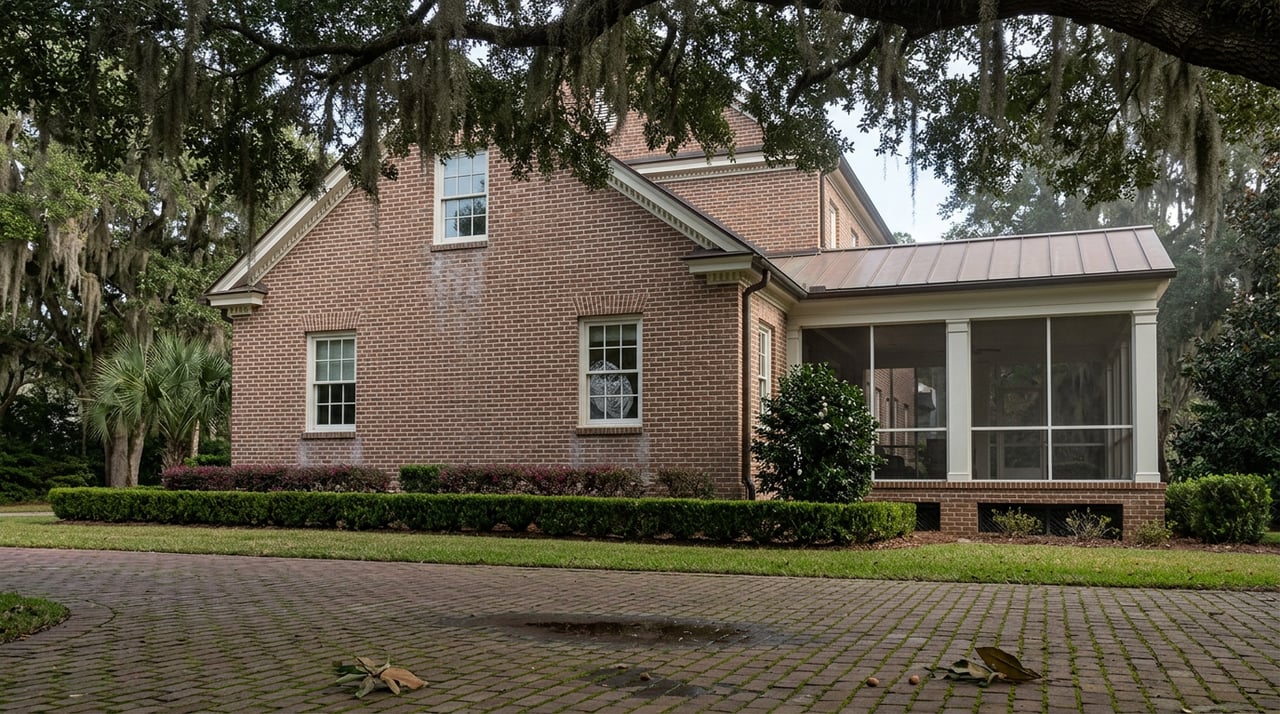
A buyer walks a home on Richmond Hill Drive under a canopy of live oaks, loves the quiet, loves the security gate, and assumes the pool and dining room in the listing photos come with the address. They don't, automatically. Buying inside Wachesaw Plantation and joining Wachesaw Plantation Club are two separate transactions, governed by two separate organizations, and the gap between them is where most of the real cost conversation happens.
That gap matters more this year than usual. The neighborhood's median sale price has dropped sharply over the past twelve months even as the club itself is in the middle of a multi-million-dollar capital project. Those two facts aren't a coincidence. They're the same story told from two sides of one gate.
One Deed, Two Decisions
Wachesaw Plantation the residential community is a property owners' association. Wachesaw Plantation Club is a separate, member-owned country club that happens to sit inside the same gates. Purchasing a home does not obligate a buyer to join the club, and the club's own membership page lays out five distinct tiers rather than a single all-or-nothing option: an Oaks Equity Membership for full-time residents who want unlimited golf, a discounted Young Adult Equity Membership for members under 40 that requires an upgrade once they turn 40 to keep golfing privileges, a Magnolia Equity Membership capped at 50 rounds a year, an Interim Equity option for owners whose primary residence sits at least 100 miles away, and a Social/Sport Membership that includes unlimited tennis and pool access but caps golf at four rounds a year per household.
The catch is that the property owners' association doesn't operate a pool, tennis court, or clubhouse of its own. Everything shared inside the gates, the pool complex, the eight Har-Tru clay tennis courts, the riverfront dining room known as Kimbel's, sits under the club's roof, not the neighborhood's. So the choice not to join isn't really a choice to keep the same lifestyle for less money. It's a choice to buy the address and skip the amenities entirely.
That distinction shows up in the housing product itself. The community is organized into named sections with their own minimum square footage rules, Richmond Hill requires at least 2,250 heated square feet, Hunters Woods requires 2,000, and Carriage Run's cottages sit lower still, which means the entry price for a Wachesaw address varies before a buyer has even considered the club question.
What the Club Actually Costs
Wachesaw Plantation Club does not publish its dues publicly and reserves the right to change pricing at any time, so exact current figures require a direct call to the membership office. One independent club-tracking site estimates initiation fees in the $30,000 to $50,000 range for equity memberships, with monthly dues estimated between $700 and $1,000, and notes some reviewers have described dues closer to $1,500 a month. Those are third-party estimates, not official numbers, and worth confirming before anyone runs the math on a specific offer.
What is documented is the guest-fee structure, since a local rental management company that oversees cottage rentals inside the gates publishes it directly. A guest playing the course pays a $108 cart and green fee plus tax. Tennis runs $15 per person per day. The pool carries no separate fee, but access to any of it depends entirely on the homeowner holding a club membership in the first place, since guests cannot use the amenities on their own.
| Membership tier | Built for | Golf access |
|---|---|---|
| Oaks Equity | Full-time or frequent residents | Unlimited |
| Young Adult Equity (under 40) | Younger residents, must upgrade at 40 | Unlimited, at a reduced rate |
| Magnolia Equity | Residents whose main interest isn't daily golf | 50 rounds per year |
| Interim Equity | Owners living 100+ miles from the club | 60 rounds per year |
| Social/Sport | Pool, tennis, and dining without regular golf | 4 rounds per year |
The Club Is Spending Right Now, and Dues Absorb It
The timing of a buyer's decision matters this year specifically. Wachesaw Plantation Club has begun a multi-million-dollar renovation, first announced in June 2026 and detailed further by MyHorryNews, that includes a completed expansion of Kimbel's restaurant deck and patio and a pool complex now under construction featuring a zero-entry pool, dedicated lap lanes, a children's pool, a hot tub, expanded decking, and new cabana lounge areas.
"Our members are at the heart of everything we do."
That's General Manager Ross Desmond, describing the project to MyHorryNews. Member-owned clubs fund capital work like this through the membership itself, whether via standard dues, a special assessment, or both. A buyer who joins mid-project is stepping into a fee structure that's actively being reset to pay for amenities that won't be finished on day one of membership. That's a fair trade for many buyers. It's also a cost that doesn't show up anywhere on a home's listing sheet.
The club has real history behind this reinvestment. Founded in 1985 on land originally developed as two rice plantations along the Waccamaw River, the property has also served as an archaeological site, with researchers documenting Native American burial mounds dating back some 11,000 years alongside the community's more recent past. That depth is part of what current members are paying to preserve and modernize at the same time.
Why the Median Price Might Be Falling While the Club Spends More
As of May 2026, the median sale price across Wachesaw Plantation sat at $587,302, down 12.9% year over year. On its own, that number reads like a cooling market. Read against the club's renovation spending, it likely reads as something narrower: a shift in which homes are actually closing, not a broad discount across every price point.
Single-family homes in the neighborhood have ranged from the $300s up to just under $1 million, condos have traded from the high $100s to the high $200s, and vacant homesites have run from under $100,000 to the high $100s. If more of this year's closings are landing in the lower bands, cottages, condos, smaller lots, while larger equity-tier estates sit longer, a falling median doesn't mean the top of the market got cheaper. It means fewer buyers are willing to take on both a large home price and the club's rising, renovation-era cost of membership at the same time.
There's a second pressure working in the same direction. Golf Digest's course rankings show Wachesaw's Tom Fazio design at 41st for 2025-'26, down from 34th in 2023-'24. A buyer weighing full equity membership against that kind of ranking slide, right as the club is asking members to help fund a renovation aimed at reversing it, has a real reason to hesitate on the highest price tier until the new pool complex and the ranking trend both prove out.
None of this means the neighborhood is struggling. Resale activity is still closing across price tiers this year, including recent transactions represented by agents with The Litchfield Company Real Estate, our own affiliated brokerage, on streets like Riverside Lane. It means the median is telling a story about mix, not about value collapsing.
What This Means Depending on Why You're Buying
A buyer who wants the gated address, the oak canopy, and quiet streets without any interest in golf, tennis, or the dining room can reasonably treat the club as optional and budget accordingly, likely landing in the cottage or condo tier.
A buyer who wants the full lifestyle, golf included, needs to treat the equity membership as a second purchase decision layered on top of the home price, one that includes today's estimated initiation and dues plus whatever the current renovation adds to the assessment conversation before closing.
Before writing an offer on any Wachesaw Plantation listing, it's worth confirming three things directly with the seller's agent and the club: whether an existing membership is transferable with this specific home, which section governs the property's minimum square footage and how that fits your plans, and what current dues and any active special assessment actually total, since the club can adjust pricing at any time without notice.
A Short FAQ
Do I have to join Wachesaw Plantation Club to buy a home in the neighborhood? No. The property owners' association and the club are legally separate, and homeownership doesn't require membership. But since no amenities exist outside the club, choosing not to join is really a choice to buy the address on its own.
If a listing says "membership included," what does that actually mean? A handful of resale listings do transfer an existing membership with the sale, but terms and eligibility should be confirmed directly with the club rather than assumed, since membership offerings and pricing can change at any time.
Wachesaw Plantation rewards buyers who ask the second question, not just the first one. If you're weighing an address against a lifestyle inside these gates, or anywhere else along the Pawleys Island to Murrells Inlet corridor, The Taylor Keenan Team can walk through the real numbers before you write an offer. Start your Lowcountry search, contact our team today.